

Written by Bruno Magro FCSI APD Board Member
A while back I was reviewing a concept design for a hotel in Southeast Asia. Someone on the project team had already run it through an AI tool — layout, equipment list, rough costs, the works. And honestly? It wasn’t bad. But it had missed something that mattered a lot. The whole concept was built around a live cooking station. That station was supposed to be the thing guests remembered. The AI had quietly removed it because it wasn’t efficient enough. Throughput looked better without it.
No algorithm knew why that station existed. I did, because I’d spent hours with the owner talking about why he got into hospitality in the first place and what he wanted guests to walk away feeling. That conversation doesn’t show up in any dataset.
That’s kind of where we are right now. AI is already in our industry. It’s not coming — it’s here, sitting inside the tools we use every day to design kitchens, specify equipment, manage operations, and advise clients. The question stopped being “should we engage with it” a while ago. Now it’s about how, and whether we’re the ones leading that conversation with our clients or just reacting to it.
One thing worth saying upfront: AI is data analytics. That’s it. It’s not magic. If the data going in is incomplete or wrong, the output is too. And most operators in foodservice have been sitting on years of useful data without really knowing what to do with it. That’s actually the bigger problem — not the technology itself.
Design
The way we design foodservice spaces is changing. You can now give an AI tool a basic brief — cuisine type, number of covers, service style — and get back a layout, an equipment list, and a cost estimate. It’s a decent starting point. Sometimes it’s a surprisingly good one.
But a starting point is all it is. The tool has no idea who the client is. It doesn’t know the quirks of the local supply chain, or that the owner’s head chef refuses to work on a line that runs a certain way, or that the building’s ventilation is going to force a compromise on the hot section. Those are the things that turn a layout into a concept that actually works. That’s still our job.
There’s also something bigger starting to happen. Kitchens are being designed not just for human teams but for automated systems working alongside them. Robotic stations. Humanoids handling repetitive tasks. It’s not science fiction anymore — the economics are starting to make sense in certain segments. Which means the design brief is getting more complicated. How humans and machines share a space, how workflows get split between them, what that means for the overall layout — this is genuinely new territory and most operators don’t have the knowledge to navigate it on their own.
Equipment
Equipment used to be hardware. You bought it, you used it, eventually you replaced it. That’s not really true anymore.
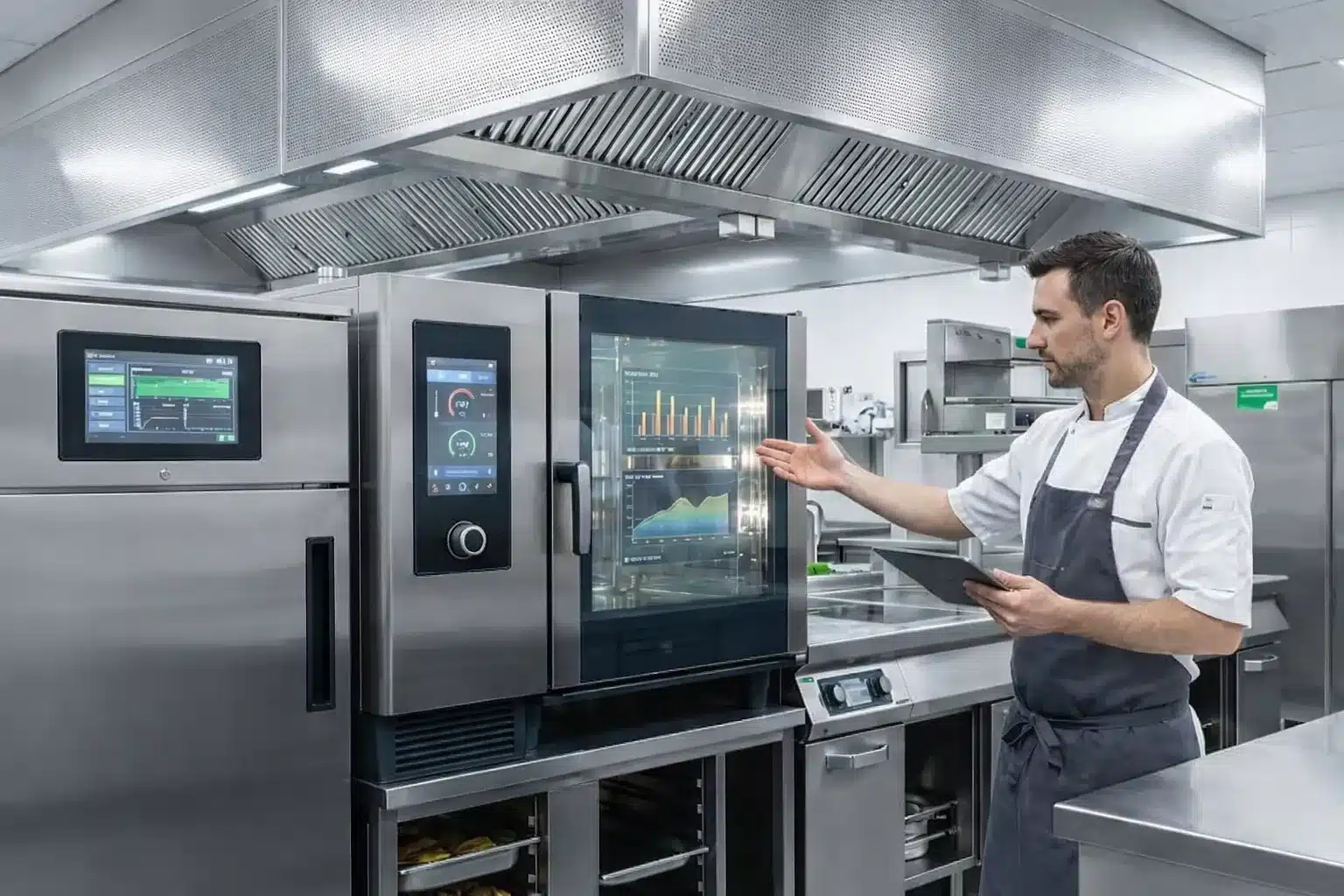
A combi oven today is also a software platform. A smart fryer logs every cook cycle. Dishwashing systems track water usage and flag maintenance before something breaks. IoT-connected equipment generates a continuous stream of data about energy, performance, usage patterns — all of it potentially useful, none of it automatically turned into decisions. Someone has to do that. Increasingly, that someone needs to understand both the operational side and the data side. That’s a new skill set, and not every kitchen team has it yet.
What this means for specifying equipment is that the conversation has changed. It’s not just about which piece of kit performs best at a given price point. It’s about what data it generates, whether that data can be used, how it integrates with everything else, and whether it’ll still make sense when the concept evolves in three years. A wrong call here locks a client in. A good one gives them flexibility. That’s genuinely high-stakes advice, and it’s exactly the kind of thing that benefits from an independent perspective.
Being part of FCSI helps here. The access to manufacturers, the education programmes, the network of people who’ve already worked through these problems in other markets — it means we’re not figuring this out in isolation. But staying current takes real effort. The pace of equipment development is fast and it’s not slowing down.
Operations
This is where things get complicated. Not technically — operationally and culturally.
AI tools for operations are real and they work. Predictive prep lists, automated ordering, demand forecasting, dynamic inventory management — these aren’t experiments anymore. They’re being used commercially across every segment. And the underlying insight is simple: the data operators need to run better has almost always existed. The problem was never that it wasn’t there. It was that nobody was using it.
I’ve seen this play out in two very different situations. A QSR that couldn’t find reliable staff for a specific station — automation solved that cleanly. A resort property in a beautiful but remote location, struggling to hold onto experienced kitchen staff — AI tools helped them maintain consistency even as the team changed. In both cases the technology wasn’t replacing the operation. It was filling a gap the operation couldn’t close any other way.
But the friction is real. Kitchen culture doesn’t change quickly. A lot of experienced chefs push back hard on screens and systems in their space — and some of that resistance is worth listening to, not just overriding. The risk of following automated outputs without understanding their limits is genuine. Operations isn’t just about plugging in tools. It’s about designing workflows where the human judgment and the machine output actually work together. Getting that balance right is harder than it looks, and it’s not something a software vendor is going to do for your client.
What This Means for Us
AI tools have made it easier for anyone to produce professional-looking work, and the consultancy space has gotten more crowded as a result. Some of those people are good. A lot are not. Which, honestly, makes what we do more important — not less — because the gap between a plausible output and a good recommendation has never been wider.
FCSI has always been about independence. No manufacturer ties. Client-first. Accountable. A tool can generate a recommendation. It can’t be held professionally responsible for what happens when that recommendation is built. We can. That’s not a small thing.
What we do need to add is technological literacy. Not become technologists — just be able to evaluate what these tools produce, understand where they’re useful and where they fall short, and explain that clearly to clients. That is part of the new skills.
Projects will be scoped differently. Fees will need to reflect judgment and interpretation rather than time spent on tasks that tools can now do faster. Client conversations will shift. All of that is fine — it’s just change, and we’ve navigated change before.
The tools will keep evolving. What stays constant is the need for someone who understands the operation, knows the client, and can make a call. That’s still us — as long as we stay close to the work.