

Written by Ben Gregoire Principal – LEVELS and Immediate Past Chair FCSI Asia Pacific
For anyone considering membership with FCSI, one of the first things to understand is that foodservice consulting is not a single discipline. It is a broad profession made up of people with different skills, backgrounds, and areas of expertise.
FCSI recognises this through its membership structure, which includes Professional, Senior Associate, Associate, Emeritus, and Student members. These categories help reflect different levels of experience, professional development, and industry contribution. They also show that there are many ways to practise as a foodservice consultant.
Some consultants focus on kitchen design, equipment specification, laundry planning, sustainability, procurement, or technical documentation. These are often the more visible parts of the profession because the outputs are tangible. You can see the drawing. You can review the equipment schedule. You can walk through the kitchen and understand how the consultant has shaped the space.
Management Advisory Services, or MAS, can be less immediately obvious.
MAS consultants often work further upstream, helping owners, developers, hotel groups, and operators make sense of the business, the guest, the market, and the concept before the first line is drawn. We help define what a project should be, why it should exist, who it is for, how it should operate, and what it needs to become successful.
In simple terms, an MAS consultant helps clients make better decisions before those decisions become expensive mistakes.
MAS Starts With Strategy
Much of the most important MAS work happens before a project looks like a project.
A client may come with a hotel development, a mixed-use precinct, an underperforming asset, or a space that has been marked as “restaurant,” “bar,” “café,” or “all-day dining.” At that stage, the opportunity may still be unclear. The space exists, the ambition exists, but the actual business idea has not yet been properly defined.
That is where MAS consultants add value.
We ask the questions that shape the foundation of the project. What is the market missing? Who is the guest? Is demand local, international, residential, corporate, leisure, or a mix of all of these? What price point is realistic? What type of experience will feel relevant in this location? What will make the concept distinct? What operational model can the client actually support? Is the idea commercially viable, or is it simply fashionable?
This is where research, benchmarking, trend analysis, feasibility thinking, and operational experience come together.
Trends are useful, but they are not strategy. A trend might tell us what people are talking about. Strategy tells us whether it belongs in this project, in this market, for this guest, at this moment.
The role of the MAS consultant is not to chase what is popular. It is to help shape what is appropriate, relevant, differentiated, and commercially sound.
We Help Define the Concept
A concept is not just a mood board, a name, or a visual direction. It is the organising idea behind the guest experience.
It should influence the design, menu, service style, music, uniforms, tone of voice, table setting, lighting, operating hours, and even how the team answers the phone. When the concept is clear, every decision has a reference point. When it is not clear, every decision becomes a debate.
MAS consultants help define and protect that clarity.
This is especially important because hospitality projects involve many stakeholders. Owners, designers, chefs, brand teams, operators, procurement teams, finance departments, marketing teams, and contractors all bring valid priorities. But without a clear concept strategy, those priorities can pull the project in different directions.
One small compromise becomes another. A strong original idea gradually becomes safer, flatter, and less memorable.
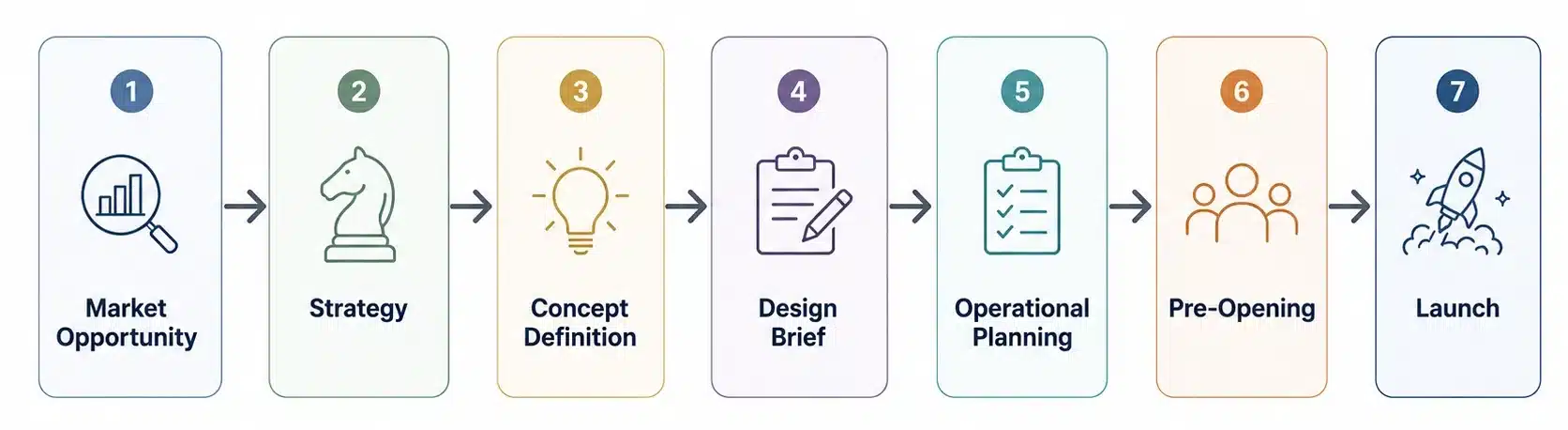
The MAS consultant helps ensure that the concept remains coherent while still allowing it to evolve. We are not there to be precious. We are there to make sure creativity stays connected to the guest, the market, and the business model.
We Translate Between Stakeholders
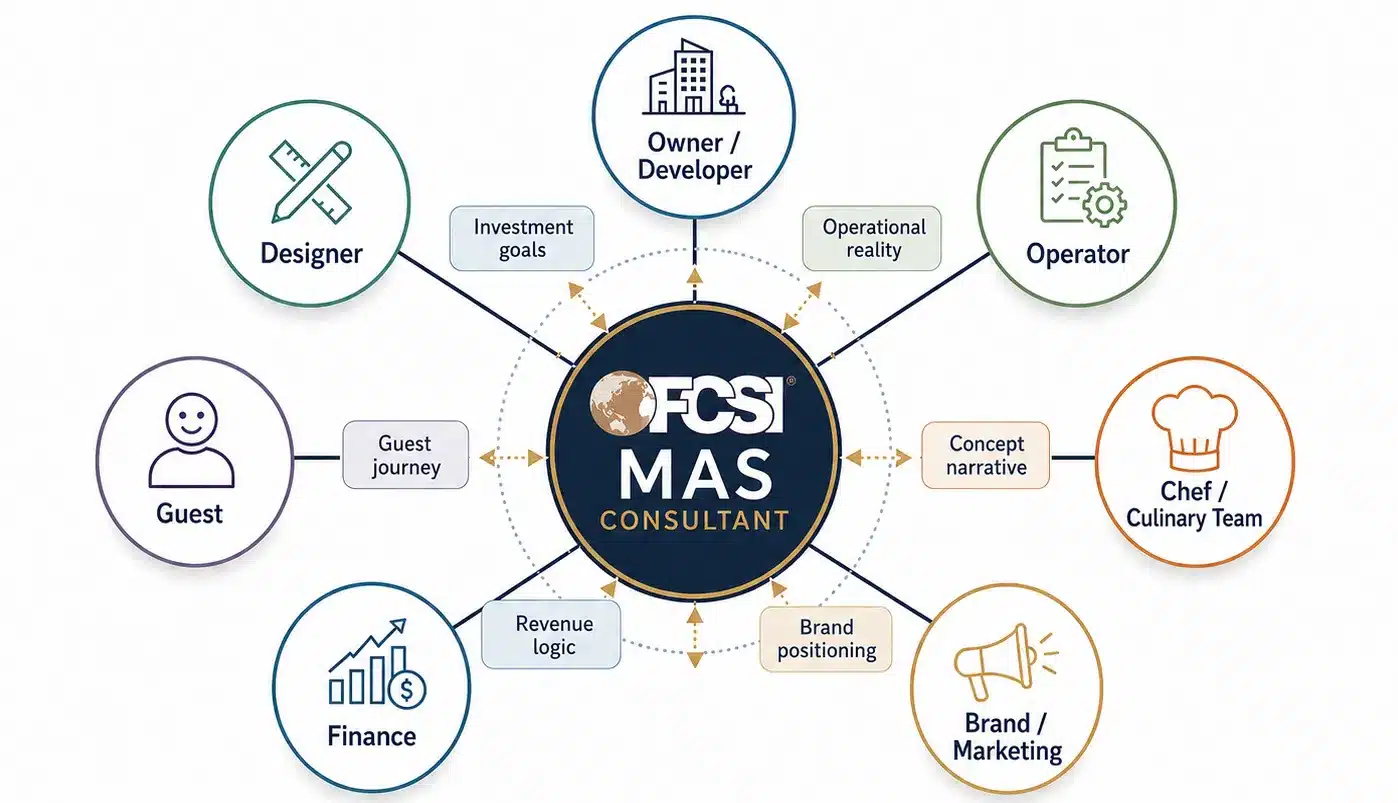
One of the most valuable roles of an MAS consultant is translation.
Owners often think in terms of investment, returns, asset value, positioning, and risk. Designers think in terms of space, emotion, form, materiality, and visual impact. Operators think in terms of staffing, workflow, maintenance, procurement, service sequence, guest complaints, and whether the ice machine is in the wrong place.
Guests do not care about any of these internal conversations. They simply know whether the experience feels good.
MAS consultants sit between these worlds.
We help owners understand what is operationally realistic. We help operators understand the commercial and brand ambition. We help designers understand the service journey and business model. We help brand teams understand the physical and human realities of the venue.
Most importantly, we help everyone stay focused on the guest.
This can include advising on outlet mix, shaping F&B strategy, developing concept narratives, reviewing layouts from an operational perspective, defining guest touchpoints, supporting pre-opening planning, and helping teams prepare for launch.
In other words, we help ensure the great idea survives contact with real life.
We Balance Creativity With Commercial Sense
Hospitality is an emotional business, but it is still a business.
A beautiful restaurant that cannot be staffed properly will struggle. A brilliant bar with an unclear market position will struggle. A hotel dining concept that photographs well but cannot deliver breakfast efficiently will struggle. The best hospitality concepts are not only attractive. They are executable, repeatable, and commercially grounded.
MAS consultants bring commercial discipline to creative thinking.
We look at how a concept will generate revenue, how it will be perceived, how it will be operated, and how it can remain relevant over time. This does not mean making every idea smaller or safer. In fact, good advisory work often gives clients the confidence to be bolder because the thinking underneath the idea is sound.
The spreadsheet and the story both matter.
A strong strategy gives creativity direction. A strong concept gives the business personality. A strong operating model gives the experience consistency. And a strong commercial foundation gives the idea a better chance of lasting beyond opening night.
We Advise, But We Also Challenge
A good MAS consultant does not simply agree with the client.
That would be easier, but not very useful.
Our job is to advise honestly. Sometimes that means validating a direction. Sometimes it means refining it. Sometimes it means saying, “This sounds exciting, but the market may not support it,” or “This will be difficult to operate,” or “This concept is too similar to what already exists.”
Clients do not need consultants to decorate their assumptions. They need advisors who can pressure-test ideas before the market does.
This is particularly important in F&B, where personal preference can easily dominate decision-making. Everyone has opinions about coffee, cocktails, breakfast, lighting, music, and whether sharing plates have finally had their moment.
The MAS consultant helps move the conversation away from personal taste and back towards the guest, the market, the operation, and the business objective.
Hospitality needs instinct, imagination, generosity, and taste. But those qualities need to be supported by clear thinking. Otherwise, the project risks becoming a collection of preferences rather than a coherent business.
We Support Operators, Not Just Owners
While MAS work often begins with owners and developers, operators are central to the process. They are the ones who must bring the concept to life every day.
A concept that ignores the operator is a liability.
It may look impressive in a presentation, but if the staffing model is unrealistic, the service sequence is too complex, or the back-of-house requirements have not been considered, the concept will eventually collapse under its own ambition.
MAS consultants help bridge this gap by thinking about operational clarity from the beginning.
How will the venue open and close? What skills does the team need? What are the critical guest touchpoints? How should the menu support the positioning? What can be delivered consistently? Where are the pressure points? What happens on a fully booked Saturday night when the general manager is off, the printer jams, and table twelve wants to split the bill six ways?
That last part is only partly a joke.
Great hospitality depends on repeatability. The magic must be deliverable more than once.
Why MAS Matters Within FCSI
FCSI exists to promote professionalism, ethical practice, knowledge-sharing, and recognition within the foodservice consulting industry. For potential members, this matters because it shows the breadth of the profession and the value of belonging to a community that understands the different roles consultants play.
MAS consultants are an important part of that community, even if our work is sometimes less visible than design or technical consulting.
We may not always produce the final kitchen drawing or equipment specification, but we help shape the strategic decisions that guide those later stages. We help clients understand what they are creating, who it is for, why it will matter, how it should work, and what will make guests come back.
That is the value of Management Advisory Services.
We bring structure to early decision-making. We turn ideas into strategies. We turn strategies into concepts. We help concepts become operational realities. We protect the guest experience while respecting the commercial investment.
In the simplest terms, MAS consultants help make hospitality make sense.
And for anyone considering joining FCSI, that is an important part of the profession to understand. Foodservice consulting is not only about the spaces we design or the systems we specify. It is also about the thinking that makes those spaces purposeful, profitable, and worth returning to.